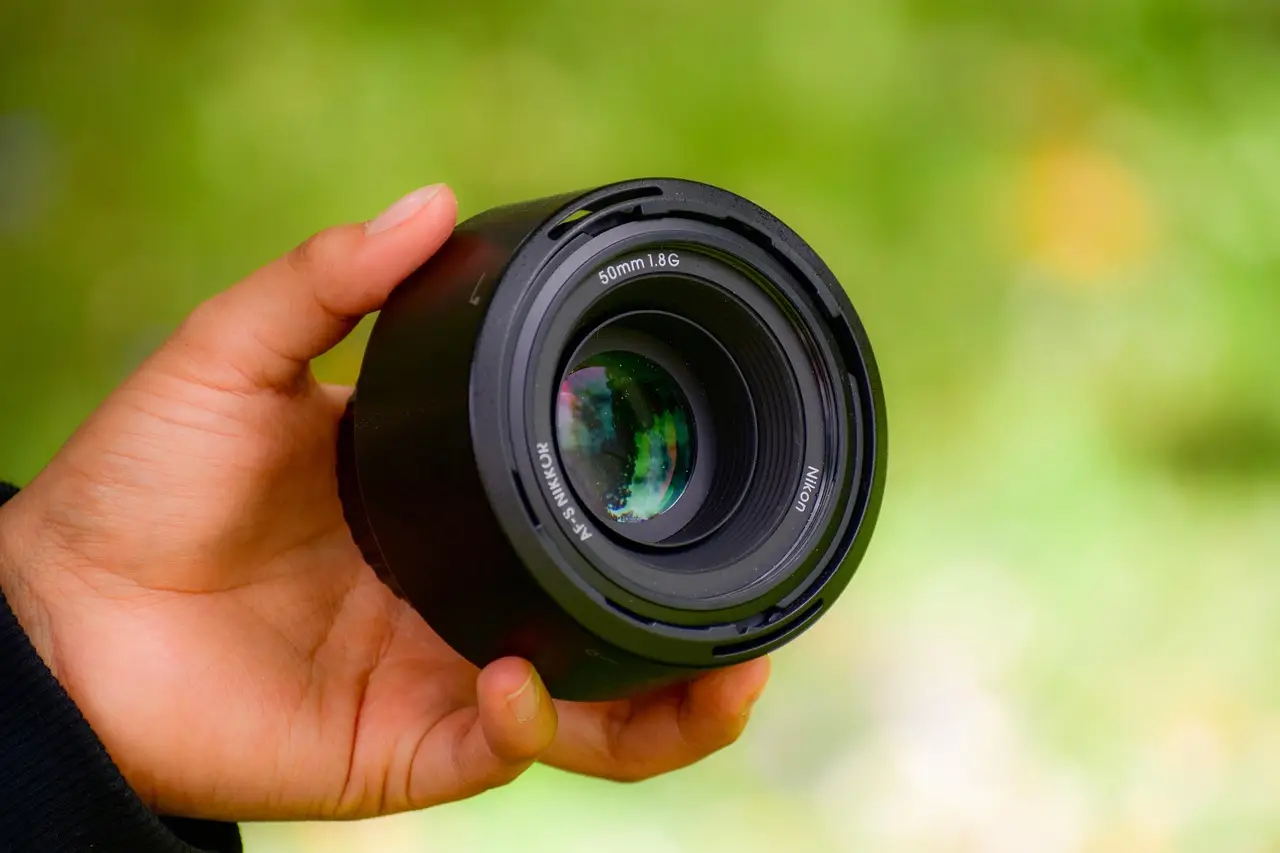
Sirui Swift 40mm f/2.2 delivers full-frame handling at $149
The $149 Sirui Swift 40mm f/2.2 delivers full-frame optics, physical aperture control, weather seals and accurate autofocus, but only three mounts and no stabilization.

Processing notes
- $149 / £129 / AU$242 for the full-frame Sirui Swift 40mm f/2.2.
- The 210g, 70x62mm lens has a 40mm focal length, f/2.2 aperture and 58mm filter thread.
- Mount options are Sony E, L-mount and Fujifilm X; no Nikon Z version is on the cards.
- Lab tests found the frame sharp throughout at f/4 and measured distortion at -0.19.
- The nine-blade aperture ring has no de-click switch or A lock; weather seals, USB-C firmware and a three-year warranty are included.
The Sirui Swift 40mm f/2.2 is priced at just $149 (£129/AU$242), putting a weather-sealed, full-frame 40mm prime with an aperture ring and customizable function button below every directly compared rival.
Sirui began as a tripod manufacturer in 2001, entered anamorphic and cine lenses in 2015, and added photographic lighting kits in 2022. Its hybrid stills-and-video camera lenses remain comparatively new; reviewer Matthew Richards recently tested the higher-end Aurora 35mm f/1.4 and 85mm f/1.4 in Sony E, Nikon Z, L-mount and Fujifilm X versions.
The Swift 40mm and 20mm f/2.4 sibling share nearly identical size, weight and handling. Sirui positions both as lightweight, entry-grade options, with the 40mm marginally faster at f/2.2 versus f/2.4.
Mounts cover Sony E (FE), L-mount and Fujifilm X; no Nikon Z version is on the cards. The review gives no dated launch or shipping schedule.
What does the $149 price buy?
Sirui bills the Swift as a high-value standard prime, a claim its specifications support despite several omissions:
- The 40mm bridges conventional 35mm and 50mm primes with a slightly wide, natural full-frame view and an effective 60mm on APS-C or in APS-C crop mode. The angle of view is 55.9 degrees.
- Autofocus uses a linear stepping motor, with a 0.4m minimum focus distance, 0.14x maximum magnification and no image stabilization.
- A nine-blade diaphragm runs from f/2.2 to f/16. The aperture ring uses one-third-stop increments and includes an Auto position at the narrow end, but the lens has no de-click switch or aperture-ring A lock.
- The optical design uses 11 all-glass elements in eight groups, including one aspherical element and two extra-low-dispersion elements. The recessed front element carries a fluorine coating.
At $719 (£579/AU$1,200), the full-frame Sigma 50mm f/2 DG DN Contemporary costs almost five times as much. Its Sony E and L-mount versions add a premium metal build, metal hood, magnetic cap and aperture ring, but not Fujifilm X.
The full-frame Viltrox AF 40mm f/2.5 Air costs $176 (£165/AU$265) in Sony E and Nikon Z. It is marginally smaller and lighter, has a slower aperture, lacks an aperture ring, Fn button and AF/MF switch, and has no Fujifilm X version.
The APS-C Viltrox AF 35mm f/1.7 Air costs $179 (£139/AU$282) in Sony E, Nikon Z and Fujifilm X. It is compact and light but lacks those three controls, leaving the Sirui better equipped on paper.
How does it handle?
The 70x62mm body weighs 210g, uses 58mm filters and suits discreet street work; a drawstring pouch and three-year warranty come with it.
The AF/MF switch works as expected but unusually sits on the right; the Fn button is conventionally placed on the left and can carry AF-hold where supported. The aperture ring provides direct control in Program and Shutter-priority modes.
Focus shifts smoothly and nearly silently, with minimal focus breathing. Sirui optimized the lens for stills and video, but there is no de-clicking function for smooth aperture adjustments.
The recessed front element adds protection and limits ghosting and flare. Its short petal hood, shared with the Swift 20mm, is less effective but adds little length; the pinch front cap fits with the hood forward.
A rubber-gasketed metal mount and seals around joints and switches support weather resistance. Fluorine coating repels moisture and grease; USB-C permits firmware updates.
What do the tests show?
Testing with a 33-megapixel Sony A7 V, Richards found swift, consistently accurate autofocus and enough sharpness for the sensor. Center and mid-frame sharpness was excellent; edges and corners held well, especially stopped down. Color looked natural, and distortion, color fringing, ghosting and flare remained controlled.
At f/2.2, the lens supports faster shutter speeds, lower ISO and shallow depth of field. Its bokeh looked smooth and natural, stayed attractive stopped down thanks to nine rounded blades, and images retained detail and contrast in dull indoor light.
Controlled Imatest Master and SFR chart results, taken across apertures and analyzed at the center, corners and midpoints, supported the field findings. Center and mid-frame sharpness was excellent; corners softened slightly until f/4, when the frame became sharp throughout. Fringing exceeded the 20mm slightly but stayed acceptable. Measured distortion was -0.19, slight barrel distortion close to zero.
Sample images came from the Bishop's Palace and Gardens and neighboring Wells Cathedral in Wells, England, combining autumn exteriors and architectural interiors at several apertures on the A7 V.
Matthew Richards said: “The Sirui Swift 40mm f/2.2 is ideal for street photography and everyday walkabout shooting.” His final verdict called it “a very attractive and supremely affordable prime lens.” He scored features, design, performance and overall quality at 4.5 stars out of five, and value at five stars.
What does this change for working photographers?
For photographers buying a walkaround prime or second full-frame lens, the practical change is a $149 route to physical aperture control, weather sealing and an Fn button. At 210g, it can ease carry fatigue; f/2.2 supports faster shutter speeds and shallow depth of field.
Nikon Z users cannot buy this mount. Hybrid shooters must accept no stabilization, no de-click control and softer corners before f/4.
For Sony E, L-mount and Fujifilm X users, the measured performance makes the Sirui a low-risk, low-cost standard-prime purchase; any expansion beyond those three mounts would determine how broadly that value reaches working photographers.
via digitalcameraworld.com (Source)
More from Grace Kim
Show full bio
News editor covering technology and product news in professional photography industry at Photo Trade Wire.
174 articles