FR-505Aƒ/11 · 1/125 · ISO 400Roll /gear-industry
Sigma fp II Review: Speed and Storage, Still No Stabilization
Sigma’s $2,199 fp II brings a faster sensor, 70 GB of storage and 6K open-gate video, while omitting a mechanical shutter, stabilization and wireless transfer.
Processing notes
- The body costs $2,199; the optional electronic viewfinder adds roughly $500.
- A partially stacked sensor largely resolves the original fp’s heavy rolling shutter, although slight tilt remains on very fast pans.
- The battery is rated at roughly 400 stills or a little over an hour of video; two batteries produced about 1,500 photos plus footage in Iceland.
- Internal storage totals 70 GB, but simultaneous internal-and-SD recording is unavailable; Wi-Fi and Bluetooth are also absent.
- Video features include 6K open-gate recording, 20 fps stills with continuous autofocus, and an electronic shutter reaching 1/25,600 s.
By Elena Vasquez
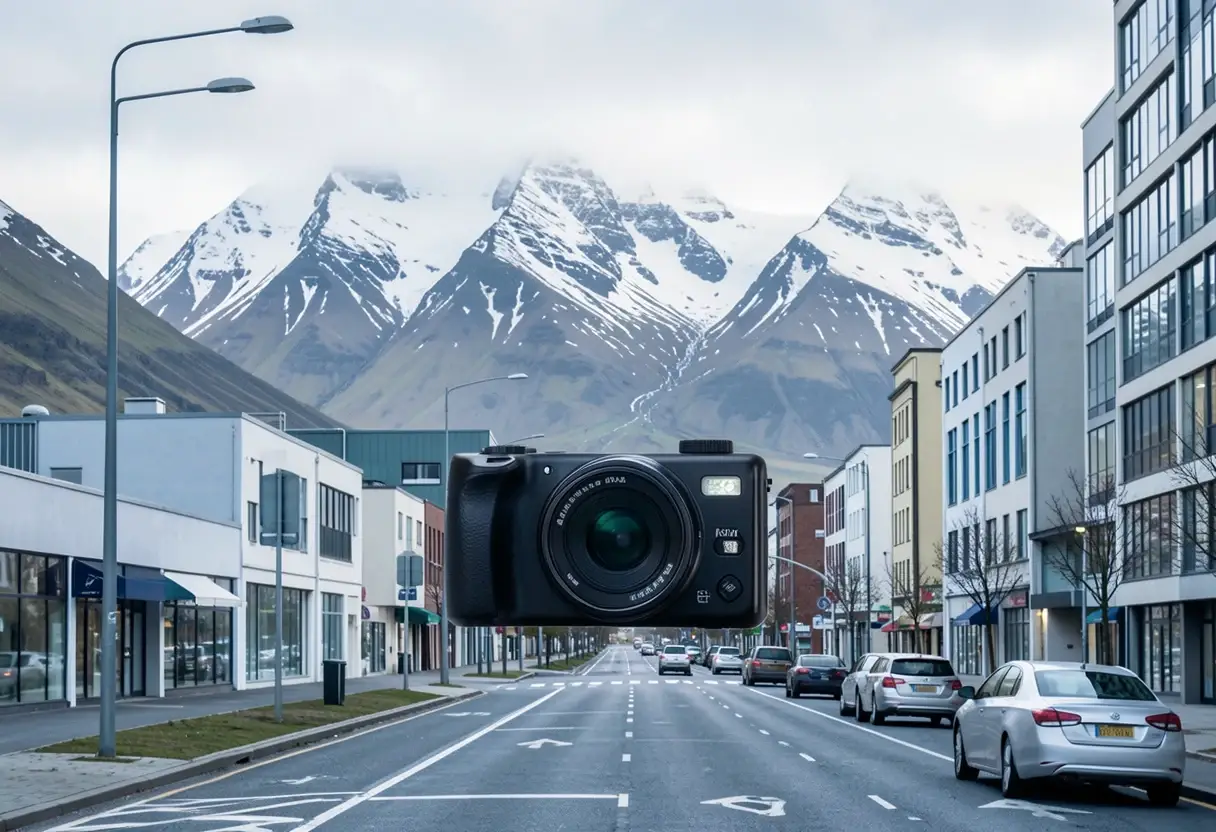
Sigma's fp II costs $2,199 for the body, with the optional electronic viewfinder adding roughly $500. It arrives without a mechanical shutter or in-body stabilization (camera-based motion compensation). Sigma bills it as “the world’s smallest full frame camera,” a useful selling point when crowded streets and mountain paths decide whether a camera leaves the bag at all.
Christopher Frost took the fp II to Iceland and set it beside the original Sigma fp. The redesign adds a faster sensor, larger battery, 70 GB of internal storage, full-size HDMI, a screen that tilts up and down, and noticeably quicker menus. For working photographers, that is a substantial upgrade list, not merely a smaller shell.
What does the fp II change for working photographers?
It improves the original fp’s weak points: readout speed and endurance. It also preserves workflow frictions, including no wireless transfer, no simultaneous internal-and-card recording, and no physical stabilization for handheld video. The practical answer depends on whether portability and open-gate video outweigh those constraints.
The sensor and battery improve
The partially stacked sensor (a faster-readout design) largely leaves the original fp and fp L’s heavy rolling shutter behind in moving stills. Rolling shutter is motion-induced skew that makes vertical lines lean when the camera moves quickly. Frost’s side-by-side clips show the improvement, though slight tilt remains during very fast pans. He compares the result favorably with many other cameras he has tested.
The larger battery uses the same model Panasonic uses in its full-size Lumix bodies. Sigma rates it at roughly 400 stills or a little over an hour of video. In cold Icelandic weather, Frost got about 1,500 photos plus some footage from just two batteries, a dramatic change from the original fp’s poor endurance. Internal storage is fast, though not fast enough for raw video.
At review time, the camera could not record to internal memory and the SD card simultaneously. A fixed glass protector simplifies sensor cleaning, while the rubber HDMI cover now stays attached rather than becoming another loose piece. There is still no Wi-Fi or Bluetooth, so moving files to a phone requires a cable.
For client delivery, that means budgeting time for the transfer ritual. Wireless convenience remains aspirational, which is a polite way of saying absent.
Where electronic shutters still bite
Electronic-only shutters have moved from oddity to mainstream in recent years. Nikon dropped the mechanical shutter on the Z9 and Z8, relying on fast stacked sensors, and used a partially stacked design in the Z6III to cut readout time without the cost of a fully stacked chip. Faster readout reduces skew, but cannot remove banding from lights pulsing with electrical power.
The practical difference appears under artificial lighting. Frequency guidance in the review produces three shooting rules:
- In the U.S., 60 Hz electricity often makes lights flicker 120 times per second; 1/120 s or 1/60 s usually keeps bands out of frame.
- On 50 Hz systems, 1/100 s and 1/50 s do the same job.
- Cheap LEDs can flicker at other frequencies entirely, so test frames under the venue’s actual lighting before the moment that matters.
Video tools, minus a steadying hand
The fp II records 6K open gate internally, a mode that uses the full sensor area. Its 4K open gate output leaves room to cut horizontal and vertical versions from one clip. For video assignments, that flexibility may matter more than the absent wireless transfer.
- Monitoring and frame tools include true 24p, zebras, a waveform, focus peaking, and a time-lapse mode.
- Exposure can be controlled by shutter angle, while the display de-squeezes anamorphic lenses for previewing.
- Raw video requires an external recorder because the internal storage cannot sustain it.
- Tally lamps on the front and top confirm recording, a small mercy for anyone who prefers visible proof.
The missing in-body stabilization hurts most in video, because the only assistance is a basic digital mode. Frost’s handheld test footage still showed plenty of vibration. He also runs 6K and several 4K modes through an ISO ladder (a sequence across sensitivity settings) to find where noise starts to intrude.
The image results are more consistent across settings than expected, although the review reports no numerical threshold. That makes this a useful field impression, not a laboratory standard.
Small body, crowded controls
In the hand, the body feels solid but not comfortable, and its small buttons can feel fiddly. Space for controls is scarce, so the quick menu becomes a regular stop for ISO and other settings, steered with both top and rear dials. Stills run up to 20 fps with continuous autofocus, while the electronic shutter reaches 1/25,600 s.
Color modes now match the Sigma BF, with old options dropped and powder blue, warm gold, and teal-and-orange looks added. Each offers adjustable strength, shadow fade, and vignetting. Autofocus now tracks humans and animals, making this Sigma’s most capable system so far.
It tracked well for Frost, though less smoothly than the best systems. In video, he saw focus “wobble now and then on still scenes” and suggests single-shot autofocus there. The review also includes a raw-versus-JPEG comparison for photographers weighing the final processing choice.
For working photographers, the fp II is most credible as a compact full-frame tool when cable transfers, one-destination recording, and digital stabilization fit the assignment. The next useful test is a full client day, where battery endurance and rolling-shutter control have to survive contact with the work.
via youtube.com (Original)
More from Elena Vasquez
Show full bio
Staff writer covering money, funding and market shifts around professional photography industry at Photo Trade Wire.
87 articles